
User Research | Internship
NVIDIA - Marketing Insights Based on User Research
Role
User Researcher
Timeline
8 weeks
Skills
User Research
Data Analysis
Tools
Sprinklr
Microsoft Office
What I Worked On
During my internship, I used social listening to provide actionable insights for a variety of teams across the company. My main intern project involved using social listening to analyze past GTC events and other similar events hosted by other companies in order to understand the needs of attendees and tailor NVIDIA’s social media content to those needs.
Problem
There was a noticeable lack of engagement with NVIDIA’s GTC content on social media compared to other brands that host similar events.
Solution
Create a dedicated social strategy around building the GTC brand
Have GTC handle be parent brand and use the other NVIDIA accounts work together to retweet/engage with that post
Post more engageable content
Contests, challenges, discussion prompts
Session-based skills challenges
Engage with users on social
Users want to feel important
Design Process
Research +
Discovery
Social listening
Empathy map
User personas
Analysis
Comparing metrics between brands to assess what works/doesn’t work
Solutioning
Consolidate what works well for brands into a cohesive steps for the marketing team to take
Research + Discovery
Social Listening Overview
I approached this project with a few key questions in mind. In analyzing other developer conferences, I focused on the language that competitors are using, the type of content that was performing the best, and whether competitors were engaging with their audience on their social platforms.
The main strategy I used for this project was social listening. Social listening involves tracking public conversations that happen on social media and drawing insights from those conversations. This data is unique because it provides unsolicited and unbiased feedback, and to do this, I used Sprinklr. Some of the KPI’s I used to measure success include mentions, which are the number of times a brand is tagged or named in a post, engagement, which is calculated by Sprinklr based on likes/comments/shares/dislikes, top posts based on engagement, and keywords, which were words that were mentioned the most on social media. We can listen to various platforms like twitter, and instagram, as well as different blog sites such as reddit, and news sites.
Empathy Map
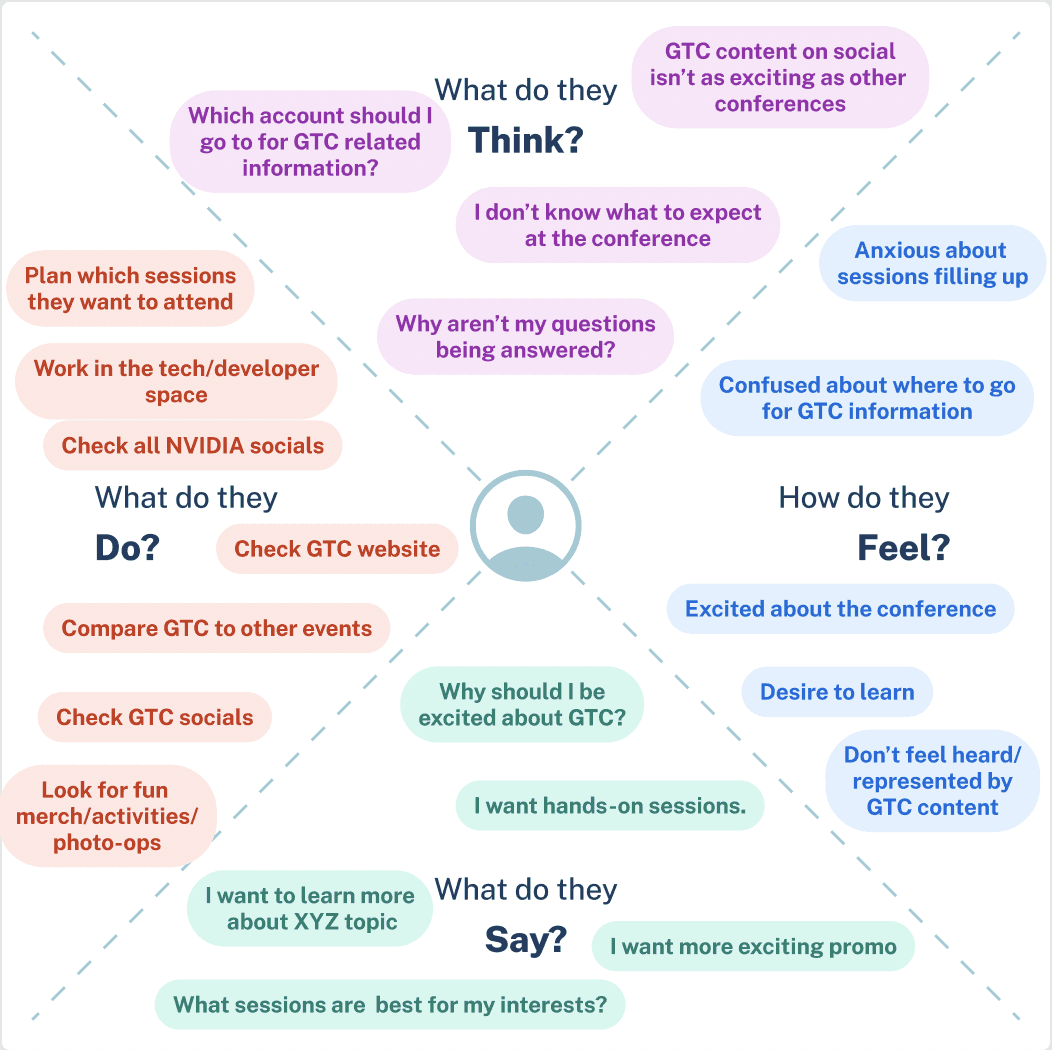
Based on the content I was seeing from the social listening dashboards, I created an empathy map to visualize user attitudes and behaviors in order get a deeper understanding of the target user that GTC content was going to be marketed to.
User Persona
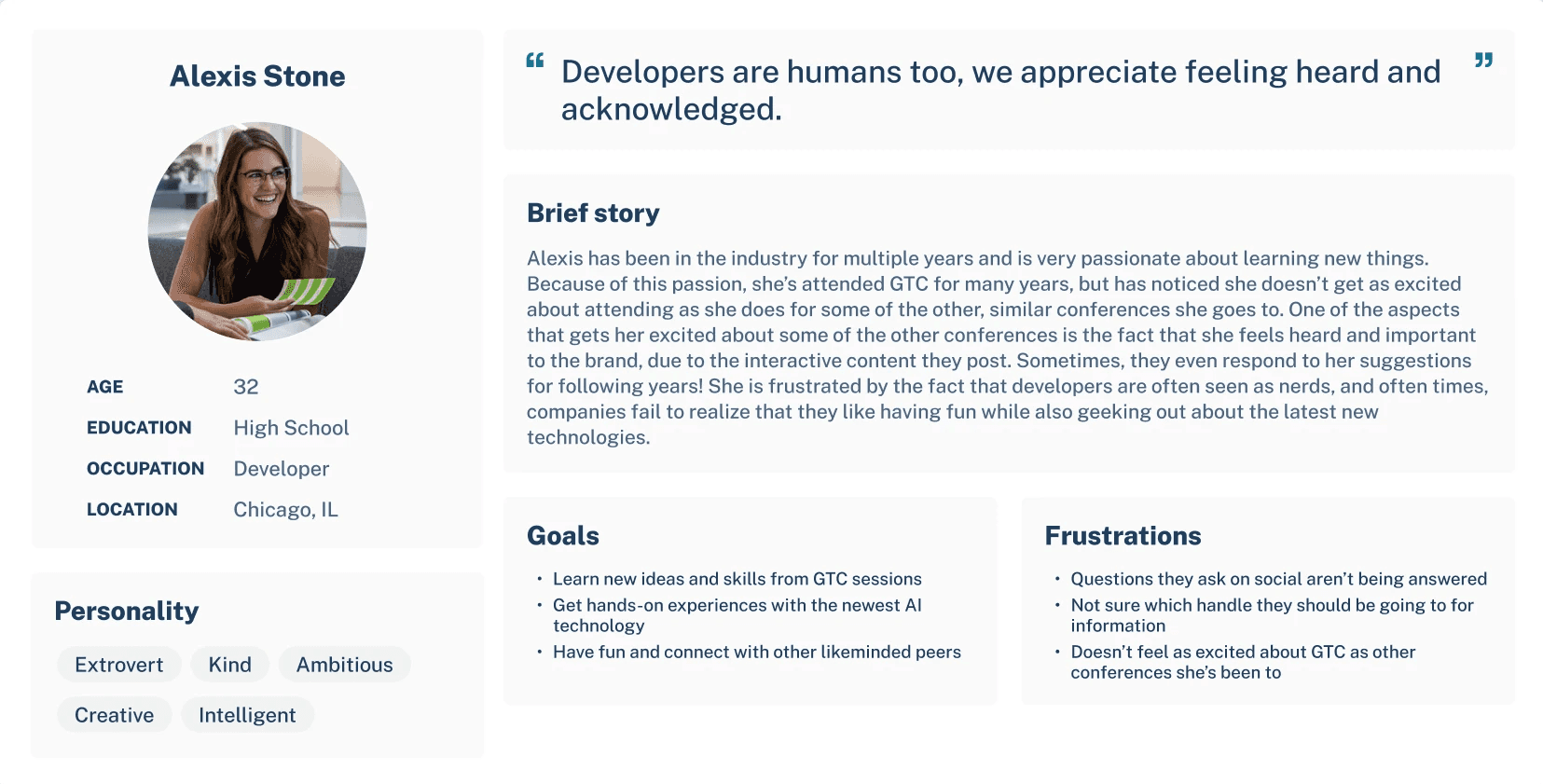
From this empathy map, I created a user persona that I could refer to when talking about the target audience to other stakeholders and leadership.
Analysis
Comparing Metrics
Based on my analysis of past GTC data, I realized that NVIDIA was not generating as many mentions as some of the competitor brands. Mentions are important because increased mentions lead to increased impressions, which means we’d be able to reach a wider audience and increase awareness of our brand. Competitor brands that are generating mentions indicated a greater user preference, as users wanted to talk about their content, so I used what was working for those competitors to create an empathy map and user persona that NVIDIA’s GTC social media marketing team should be focused on.
Some key takeaways were that users love content that makes the event seem exciting as well as smaller, intimate sessions that encourage personalized learning. Videos are also performing well, and people enjoy taking part in contests and discussion prompts. Additionally, users respond well to brand engagement.
Solutioning
Creating Actionable Next Steps
Some of my overall recommendations included creating a dedicated social strategy around building the GTC brand, especially on Twitter because that’s where they can really increase the number of mentions they're getting. The GTC twitter handle should be the parent brand and the other NVIDIA handles can work together to engage with/retweet their posts (seeing MS do this and it’s working well for them). Having a dedicated social strategy around building the GTC brand is primarily to bring awareness to the fact that the NVIDIA GTC handle exists, because its following is pretty small right now.
The GTC socials should also have more engageable content such as contests/discussion prompts, since they will generate more conversation and bring our mentions up. Additionally, it gives users more of an incentive to interact with our content and makes them more excited for future content.
Responding to users that interact with GTC content is equally as important as creating engageable content because it will foster a sense of community, especially if they’re seeing GTC admin address issues that they bring up.
CHALLENGES/LEARNINGS
📣 Building confidence
This was my very first internship, so I had a large learning curve in terms of understanding when and how to speak up and be vocal. At first, I was hesitant to contribute in meetings because I thought I was too young/inexperienced to contribute in a valuable way. I quickly realized that my youth gave me an advantage because I had a fresh new perspective, especially when it came to the realm of social media marketing. I was more familiar with what other brands were doing and the tactics they were using, so I was able to leverage that to provide meaningful insight.
🕒 Understanding the value of research
The main focus of this project was the user research, which at first I was reluctant about. I was worried that the work I was doing would be difficult to showcase and that the summer would be wasted. I ended up being really glad that I had this opportunity to hone in on just the research because it made me appreciate the entire design pipeline so much more. A design not based in research is the epitome of ineffectiveness. During my time at NVIDIA, every sentence I presented had to be backed up by numbers from my research, and I realized that design is the same way. Every design choice being made must be backed up by research in order to be taken seriously.
a quick note
As part of my final deliverable, I created a visual report with the exact infographics and statistics for the different analyses I completed. For the sake of confidentiality, I haven't included it on this page but if you have any further questions feel free to contact me to discuss!